



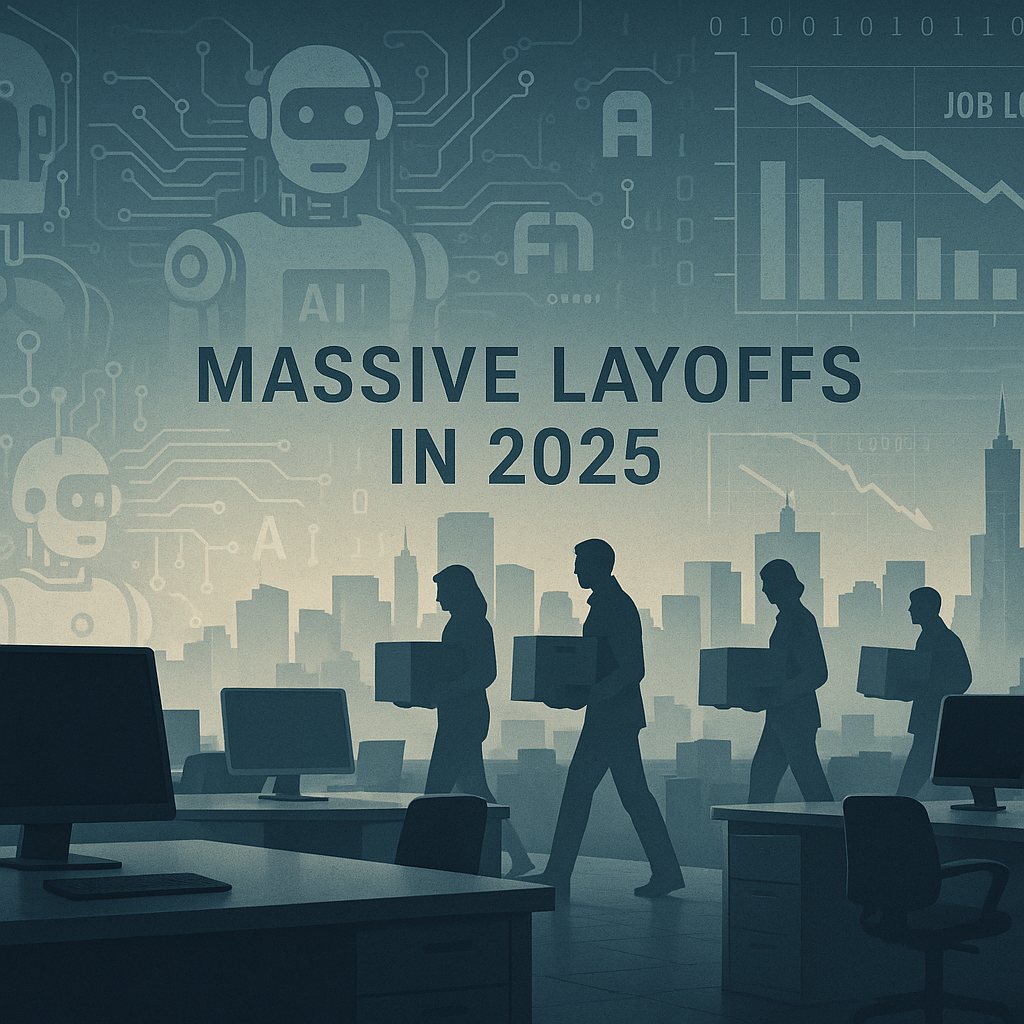
Tech Industry Layoffs Reach Another Peak in Mid-2025
TechCrunch reports over 16,000 layoffs in July 2025 alone, reflecting ongoing restructuring as companies pivot toward automation and AI, while seeking efficiency amid economic pressure. The wave represents the third major downsizing cycle since 2022, with companies citing AI transformation and economic uncertainty as primary drivers.
Layoff Trends
Layoffs rose sharply—with earlier months like April exceeding 24,500 cuts—highlighting industry-wide shifts in staffing strategy and investment. Meta led with 8,500 layoffs, followed by Amazon (7,200) and Google (5,800). The pattern shows traditional roles being eliminated while AI-focused positions increase by 35%.
Broader Implications
- AI and automation emerging as disruptive workforce factors
- Short-term job losses could coincide with new roles in AI development and deployment
- Companies are recalibrating priorities—leaner teams, more focus on AI tools
- Average severance packages increased to 4.2 months compared to 2.8 months in 2023
- 70% of laid-off workers finding new positions within 6 months, primarily in AI startups
- Remote work policies being reversed as companies consolidate operations
Regional Impact Analysis
Silicon Valley bore the brunt with 45% of total layoffs, while Austin and Seattle saw 20% and 18% respectively. International offices experienced proportionally fewer cuts, suggesting a strategic shift toward global talent distribution.
Market Response
- Tech stock indices initially dropped 3.2% but recovered within two weeks
- Venture capital funding for AI startups increased 67% during the same period
- Traditional tech company valuations stabilizing around new operational efficiency metrics
Future Workforce Predictions
Industry analysts predict stabilization by Q1 2026, with new job categories emerging in AI ethics, human-AI collaboration, and automated system management. The transformation is expected to create 2.1 million new positions while eliminating 1.8 million traditional roles.