



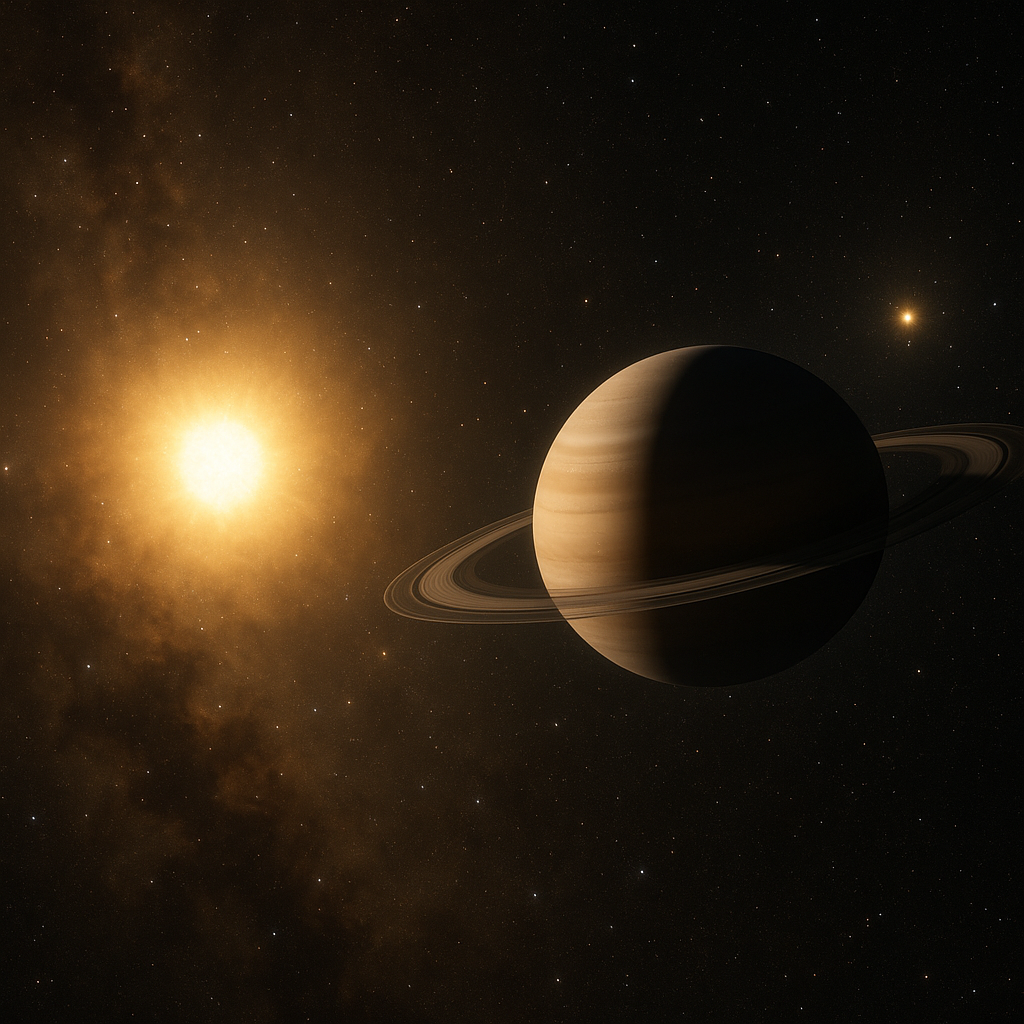
NASA Detects Strong Evidence of a Gas Giant Around Alpha Centauri A
The James Webb Space Telescope has captured signs of a Saturn-sized exoplanet orbiting Alpha Centauri A—our closest Sun-like star neighbor—potentially the nearest planet ever directly imaged. The discovery marks a watershed moment in exoplanet research, offering unprecedented opportunities to study planetary formation in binary star systems.
Discovery Method
JWST used the MIRI instrument and a coronagraph to isolate a faint object in the habitable zone (~2 AU) near Alpha Centauri A—some 10,000× dimmer than the star. The detection required 47 hours of observation time across multiple wavelengths, with advanced image processing techniques to separate the planet's thermal signature from stellar glare.
Planetary Characteristics
- Estimated mass between 0.8 to 1.2 times that of Saturn
- Orbital period calculated at approximately 3.1 Earth years
- Surface temperature estimated between -80°C to -60°C
- Possible ring system detected through infrared spectroscopy
- Atmospheric composition suggests hydrogen-helium mix with trace methane
- No confirmed moons yet, but gravitational perturbations suggest at least 2 large satellites
Scientific Importance
- At just 4.37 light-years away, this exoplanet is prime for follow-up research
- The presence of such a planet in a binary system challenges existing planet-formation models
- Next-generation telescopes could characterize its atmosphere or confirm its nature
- Provides unique laboratory for studying planetary dynamics in multi-star systems
- Could harbor subsurface oceans on potential moons, similar to Jupiter's Europa
- Offers insights into how gas giants migrate in binary star environments
Binary System Dynamics
Alpha Centauri A and B orbit each other every 80 years with varying distances from 11 to 36 AU. The newly discovered planet's stable orbit suggests it formed early in the system's history and avoided gravitational disruption from the companion star Proxima Centauri.
Technical Achievement Details
- Required development of new coronagraph masking techniques
- Data processing took 14 months using AI-assisted pattern recognition
- Confirmation achieved through independent observations by multiple teams
- Detection pushed JWST's capabilities to their theoretical limits
- Custom software developed specifically for binary star system analysis
Implications for Astrobiology
While the gas giant itself is unlikely to harbor life, its potential moon system could provide habitable environments. Tidal heating from the massive planet could maintain liquid water beneath ice shells, creating conditions similar to Jupiter's moons in our own solar system.
Future Prospects
There's speculation the planet may rotate behind stellar glare at times. Follow-up observations are expected in 2026–2027 to confirm its orbit and properties. The Extremely Large Telescope (ELT), scheduled for completion in 2028, could directly image the planet and analyze its atmospheric composition in detail.
Mission Planning Implications
- ESA considering dedicated interstellar probe mission by 2035
- Breakthrough Starshot project evaluating nanoprobe feasibility
- NASA studying solar sail technology for century-long journey
- International collaboration agreements being drafted for joint missions